The Next Architecture of Search, AI Agents & Digital Discovery
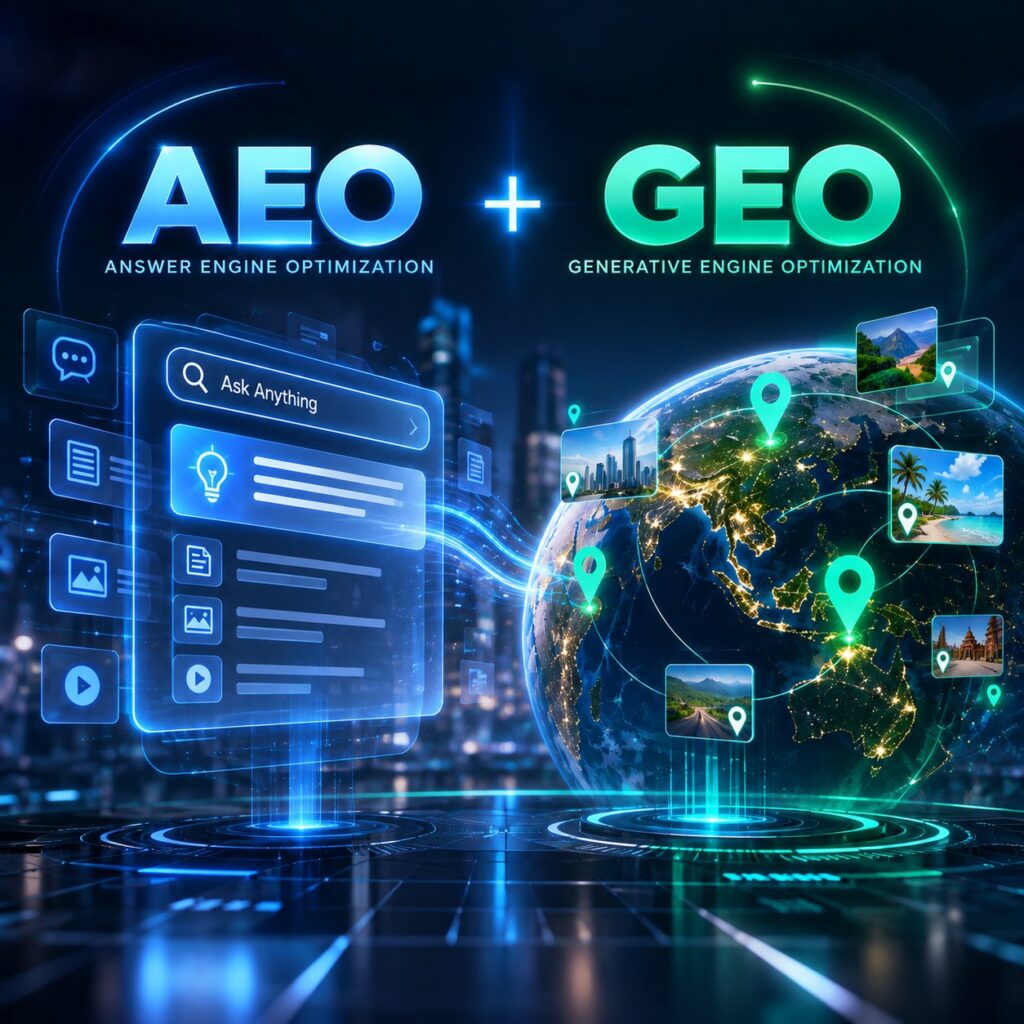
AEO (Answer Engine Optimization)
AEO (Answer Engine Optimization) focuses on making information easy for AI systems to understand and use when generating answers.
GEO (Generative Engine Optimization)
goes further—helping brands, entities and information become discoverable and accurately represented across generative search environments.
The next phase of search is not simply about ranking a webpage. AEO and GEO are evolving into something much deeper than FAQ optimization or AI-friendly content.
1. Search Is Moving From Ranking to Retrieval
Future search systems increasingly operate through query decomposition, retrieval, reasoning, synthesis and citation.
A complex query may be broken into multiple sub-queries, retrieved from different sources, semantically reranked and then synthesized into one response.
That changes the optimization target:
Page-level ranking → passage-level retrieval → claim-level attribution
The important question becomes:
Can an AI system retrieve the exact evidence required to support a claim about your business?
2. Entity Resolution Will Become Critical
AI systems need to distinguish between similarly named companies, products, people and services.
The future of GEO therefore depends heavily on entity resolution:
Who are you?
What do you own?
What do yoA company should increasingly be treated as a structured entity graph rather than a collection of webpages.
Brand → Organization → External References provide
Oceanic Inspiration
Semantic Chunk Engineering
Long-form content will increasingly need to be designed for machine retrieval.
A 4,000-word article should not be treated as one giant document.
Its architecture can contain independently meaningful units:
Claim → Evidence → Context → Example → Related Entity
GEO Will Become Agent Optimization
The bigger shift is from AI answering questions to AI performing tasks.
When an AI agent needs to:
discover → evaluate → compare → interact → execute
a normal webpage is no longer enough.
The voyage had begun, and had begun happily with a soft blue sky, and a calm sea.
MCP + A2A Point Toward a Machine-Interactive Web
Protocols such as MCP and A2A represent an emerging direction toward agent interoperability.
The broader architectural concept is:
Websites → APIs → Agent Interfaces → Agent-to-Agent Networks
As software agents become more capable of discovering tools, exchanging information and interacting with services, websites may increasingly become machine-interactive systems rather than passive information pages.
GEO Observability Will Become a New Discipline
- AI-generated summaries
- Conversational search
- Voice assistants
- Chat interfaces
- Visual searchImage-based queries
- Video search
- Shopping assistants
- Maps and local discovery
- AI-powered recommendation systems